

- Projects
- Insights
-
Careers

Careers
Ranked a Top Workplace and ENR Top 500 Design Firm, Burns offers opportunities to inspire, create and deliver transformational projects that last generations.
- News + Events
-
About

About
Burns inspires, creates and delivers specialized-engineering solutions for mission-critical facilities.
- Offices

-
What We Do
Discipline
Expertise
Industry-Specific - Projects
- Insights
- Careers
- News + Events
- About
- Offices

 Contact Us

"*" indicates required fields
California’s Push Against Federal Headwinds to Reach 100% Zero-Emission Transit Goals


Previously published in METRO.
One year into the current administration in Washington, the transit sector has only seen new federal funding for “low-emission” transit bus projects in 2025. Judging by 2025 federal funding awards, Federal Transit Administration (FTA’s) recent policies have been ‘Zero funding for zero emissions.’
In contrast to this, the State of California remains steadfast in its commitment to being a national leader in the zero-emission transit space. Governor Gavin Newsom’s administration views zero-emission transit as a core policy initiative and a point of resistance to recent federal rollbacks.
The resulting tug of war between national funding policies and state regulations leaves California transit operators in an awkward and uncomfortable position. From solar and wind farms to EV subsidies for private automobiles, federal funding for zero emissions technology projects has evaporated in 2025-2026, and transit operators in California are now caught in the middle.
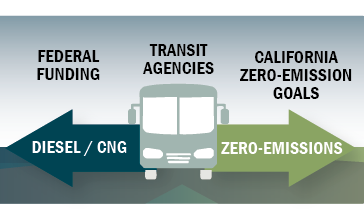
During the grant funding process throughout 2025, the FTA had encouraged transit agencies nationwide to reallocate “Low-No” (Low or No Emission) funds to purchase conventional diesel-electric hybrid or natural gas vehicles. In other cases, funding simply dried up. For example, the ARCHES hydrogen program—a $1.2 billion federally funded hydrogen initiative—was “paused” last year by FTA, suspending new hydrogen projects and removing critical operational subsidies. This could impact transit operators who could see hydrogen fuel costs spike and face severe operational pressures to continue running hydrogen buses.
History of California’s Role in Setting Emission Regulations
Since the 1960’s, California has played a central role in setting air quality standards in the United States. In response to the growing smog crisis in the Los Angeles region, Congress passed the federal Air Quality Act (1967) and Clean Air Act (1970); these regulations provided California with the unique authority to develop its own air quality standards. Despite numerous challenges (including ongoing challenges with the current administration), California’s and California Air Resource Board’s (CARB) regulatory authority has withstood over 50 years of legal challenges. Today, CARB remains the only regulatory agency in the United States allowed to develop emission regulations ahead of the EPA. Because other states can adopt California’s regulations, CARB’s zero emission bus regulations (known as the Innovative Clean Transit or “ICT” rule in the transit industry) have become the sole alternative to current federal EPA regulations.
California Continues
Even in the face of federal funding shifts, California continues to advance its zero-emission agenda, enforcing and funding its regulatory framework against federal obstacles. The state has recently committed to purchasing over 2,000 battery-electric and 100 hydrogen buses; CA transit agencies collectively account for about 10% of the total US transit market.
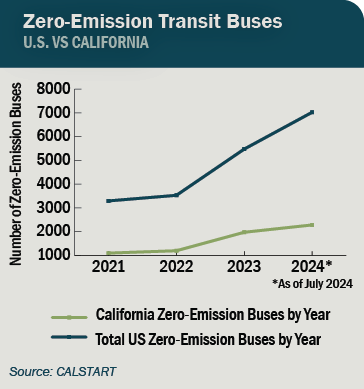
Under CARB’s ICT rule, transit agencies are directed by state mandates to purchase increasing quantities of zero-emission buses, with only limited, short-term exemptions. After 2029, CARB’s ICT rule prohibits the purchase of new non-zero-emissions buses.
The good news for California transit operators is that CARB and the state have been putting their money where their mouth is. While the FTA was announcing their “Low/No” awards (a.k.a “All ‘Low’ and no ‘No’”), California’s governor’s office and legislature re-allocated over $360 million in funding to support zero-emissions programs at the state level. Although California received almost $250 million less zero-emissions funding in the 2025 Low/No awards (compared to 2024), at least some state funding was reprogrammed to help offset some of California’s federal funding losses.
LA Metro, the largest transit operator in California and second largest in the nation, remains committed to transitioning to zero-emission buses. While the agency recently cancelled a zero-emissions bus solicitation, Amy Romero, LA Metro’s Deputy Executive Officer for Zero-Emissions Bus Acquisition and Infrastructure Implementation, says she still expects to be able to put new zero-emissions buses into service in accordance with their Zero-emission Bus Program Master Plan and has already released a new solicitation. LA Metro adopted its own zero-emission plan in 2017, and the agency remains committed to 100% transition to zero-emissions bus regulations. While the region’s early ambitions for reaching 100% zero-emission operations for the 2028 Olympics are likely unachievable, the transit agency is already in the process of converting three of its largest operating divisions and several hundred buses to battery-electric operations ahead of the 2028 games.
The Current U.S. Landscape
CARB staff have continually re-emphasized California’s determination to pursue zero-emission goals despite funding and regulatory challenges. The central issue remains: Will California’s resolve set a decisive example for zero-emission transit agencies nationwide?
Securing funding remains the core challenge for zero-emission projects, which depend on competitive federal and state grants. Doran Barnes, CEO of Foothill Transit, likens this process to “funding projects with lottery tickets.” Most agencies only act to buy zero emission buses if a grant is awarded—otherwise, they postpone projects until more funding becomes available.
Federal funding cuts are making zero-emissions technology choices a high-stakes game of poker. Erin Rogers, CEO of Omnitrans in San Bernardino, CA, shared that Omnitrans pays over $20 per kilogram of hydrogen gas, five times more than the fuel for their older compressed natural gas (CNG) buses. Additionally, their operations struggle to keep more than two of their four hydrogen buses in service at the same time. In discussing the issues with zero-emissions bus funding, Rogers indicated their big challenge is preventing the zero-emissions program from impacting their core business of service delivery. Put another way, Omnitrans is trying to be pragmatic, not to overcommit to untenable zero-emissions projects, and to wait and see how/when zero-emissions technologies mature as reliable, cost-effective options for their fleet’s operation.
Other agencies face similar struggles. During a recent tour of one California transit fleet’s hydrogen fueling operation, agency staff acknowledged that their hydrogen fueling operation could lose up to 40% of their delivered cryogenic hydrogen through evaporation and fueling process losses before it is even dispensed onto a bus. Given the range limitations of current battery-electric buses, ZEB technologies are still years away from providing a 1:1 replacement for conventionally powered transit buses. Not surprisingly, there are active discussions between California transit agencies and CARB about granting waivers to stringent ICT rule requirements and deadlines.
Other states—such as Washington, New York and Massachusetts—are watching California’s moves closely. During the last five years, over 15 states have followed California’s lead in adopting zero-emissions bus regulations. Some, like New York’s MTA, have reportedly been asked to consider redirecting federal funds toward conventional bus fleets. Others, like Massachusetts Bay Transportation Authority (MBTA) are temporarily pausing their plans for zero-emissions buses and investing in a methane-based biofuel program. Outside of metro and regional transit organizations, economic forces are driving adoption in industries where it makes practical sense. California remains the conspicuous hold-out, continuing to require full transition plans for all state transit operators by 2040.
Pragmatism, Not Politics
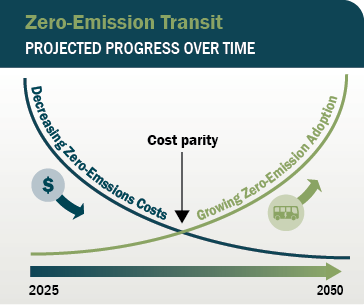
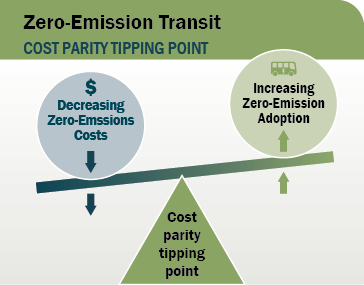
The next 2-3 years are likely to continue under this policy environment, meaning agencies must navigate conflicting federal and state priorities. California’s persistence could become a testing ground for how other states maintain long-term zero-emission commitments without federal alignment. Economic fundamentals—not mandates—will ultimately decide the pace of adoption. Battery-electric bus technologies at least appear to still be on track to reach a cost tipping point by the mid 2030’s (where battery operation is at parity with conventional propulsion technologies). It remains to be seen whether hydrogen programs can be viable without federal subsidies.
What is the Future of Zero Emissions?
Transit fleets shouldn’t get caught off guard when the zero-emissions pendulum swings back the other way. Other transportation sectors, including school buses, demand response, utility vehicles, and last-mile delivery fleets (e.g., FedEx, Amazon), are increasingly embracing zero-emission technologies for cost and reliability reasons, not politics or subsidies. As battery costs fall and zero-emissions technologies continue to mature, zero emission fleets will reach a tipping point where they are the most cost-effective solution. Initially, it will be short-range and high-frequency applications. In the longer term, zero emissions should migrate into long-haul and heavy-duty sectors. For each mobility sector, there will be a tipping point where cost-effective zero-emission operations have reached parity with fossil fuels. The question’s never been about whether zero emissions arrive, but when will zero emissions arrive.
A Steady Path Through Uncertainty
The story of zero-emission transit is far from over. Despite funding shifts and policy turbulence, momentum continues, driven by technology improvements and long-term cost advantages.
Three key takeaways for the zero-emission market in 2026:
- Federal funding, at least for the next two years, will be limited.
- California, and potentially other states, remain committed to zero-emission transit.
- Zero-emissions technologies will continue to mature, with continued improvements expected in costs and reliability.
Additionally, with transit agencies and city planners nationwide, the path forward is clear:
- Plan for evolving regulatory conditions.
- Whenever grant funding is awarded, transit agencies should move aggressively to implement the program and lock in funding commitments.
- Engage trusted partners with deep expertise in navigating the intersection of technology, policy, and infrastructure.
Burns is a trusted partner in zero-emission mobility solutions. We stand by our record of helping agencies like the Santa Clara Valley Transportation Authority and New Jersey Transit and remain committed to helping agencies and municipalities evaluate options, structure resilient programs, and make data-driven decisions as the zero-emission transition evolves.
Featured photo: “LA Metro BYD K9M” by Jason Lawrence, CC BY 2.0 (cropped from original)





