

- Projects
- Insights
-
Careers

Careers
Ranked a Top Workplace and ENR Top 500 Design Firm, Burns offers opportunities to inspire, create and deliver transformational projects that last generations.
- News + Events
-
About

About
Burns inspires, creates and delivers specialized-engineering solutions for mission-critical facilities.
- Offices

-
What We Do
Discipline
Expertise
Industry-Specific - Projects
- Insights
- Careers
- News + Events
- About
- Offices

 Contact Us

"*" indicates required fields
Turning Toward the Future: Transformative Technologies to Reduce Aircraft Turnaround Time


Reducing aircraft turnaround time is one of the most effective ways airlines and airports can lower operating costs, improve efficiency, and maximize asset utilization. Over the past decade, advances in ramp technology have provided new opportunities to streamline ground operations while enhancing safety. As a result, airlines and airports are increasingly investing in ramp improvement solutions, both as part of new terminal developments and through retrofits of existing gates and infrastructure.
Today, a combination of proven and emerging technologies is transforming ramp operations. These solutions address critical areas that affect every carrier and ground handling team, including turnaround speed, ramp safety, baggage loading and unloading, and crew positioning. By optimizing these processes, Burns helps airports and airlines reduce delays, improve resource utilization, and lower the operational costs associated with every aircraft turn.
Transformative Technologies
Visual Docking Guidance Systems
Visual Docking Guidance Systems, or VDGS, combine scanner, camera, and display technologies to guide aircraft to their final stop position at each gate. This improves aircraft positioning accuracy and reduces delays caused by crew repositioning or weather-related disruptions. Because VDGS technology is compatible with typical aircraft types, it can support a wide range of airline operations while helping standardize the arrival process at the gate.
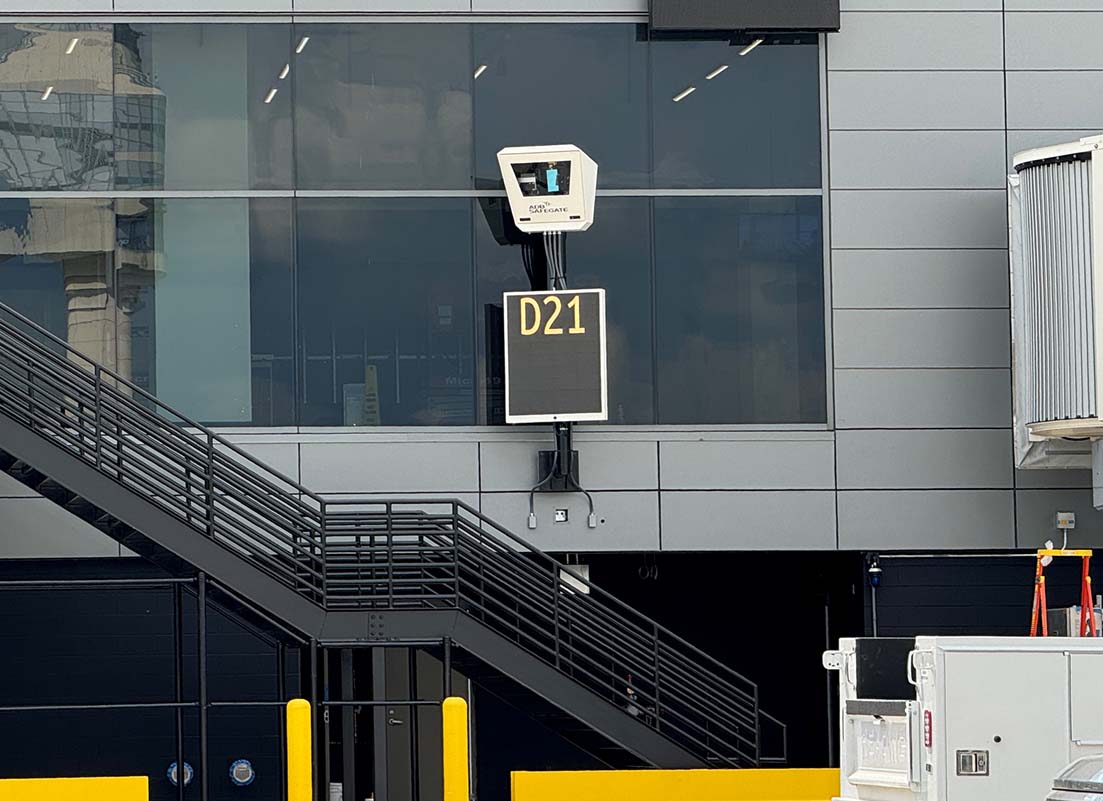
Visual Docking Guidance System (VDGS) | Courtesy of ADB Safegate
Ramp Information Displays
Ramp Information Displays, or RIDS, are large-format displays placed at each gate to provide key operational information. This may include upcoming flight figures, validation of flight numbers, gate departure time, and other critical updates. By giving ramp agents clear, real-time information at the point of operation, RIDS supports on-time departures and improves flight coordination across ramp teams.
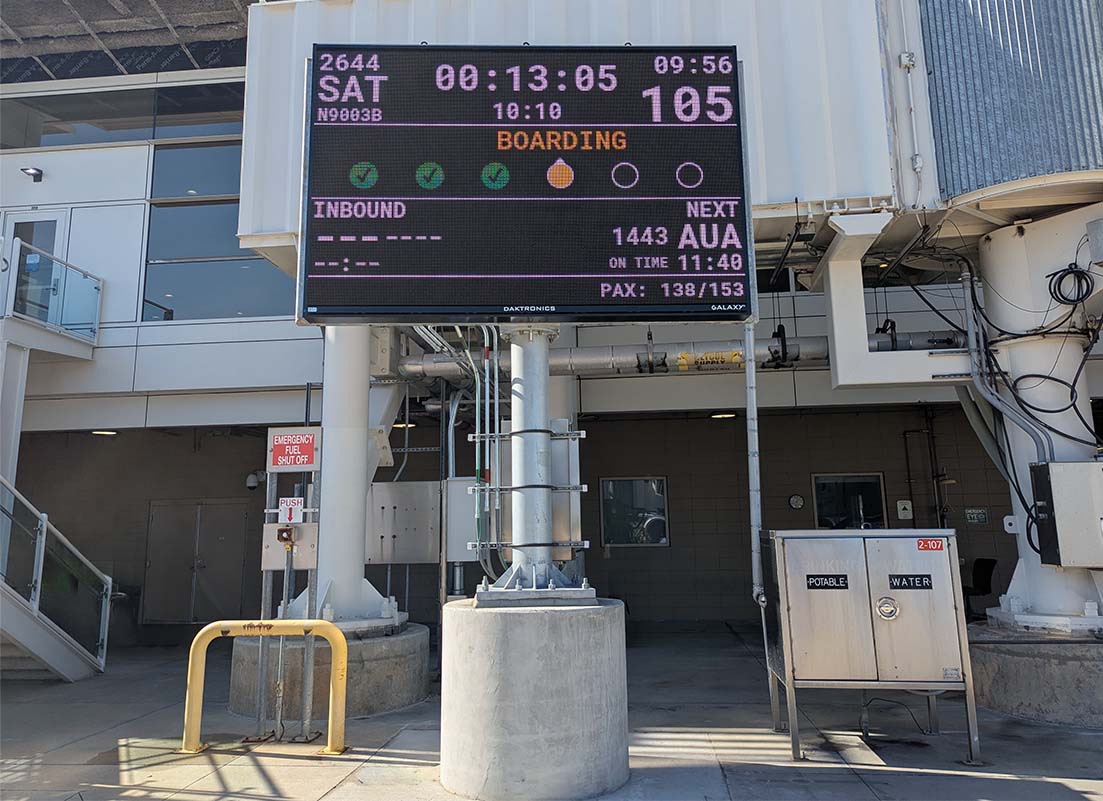
Ramp Information Display System (RIDS)
Video Surveillance Systems (VSS) software
Video Surveillance Systems software, or VSS software, utilizes existing or dedicated cameras along the airfield to improve monitoring and alert staff to issues in real time. When paired with stand management capabilities, VSS software helps airports maximize capacity within existing infrastructure and optimize gate management. Together, these tools give operators greater visibility into ramp activity and allow them to support more efficient gate operations.

Airport surveillance cameras
Implementation Options
These technologies can be deployed either by airlines across their networks or by airport operators at individual facilities. The right approach depends on local operating agreements and the division of responsibilities between carriers and airports. In either model, successful implementation requires early coordination among operations, engineering, manufacturers, and airport stakeholders.
Airline Deployment
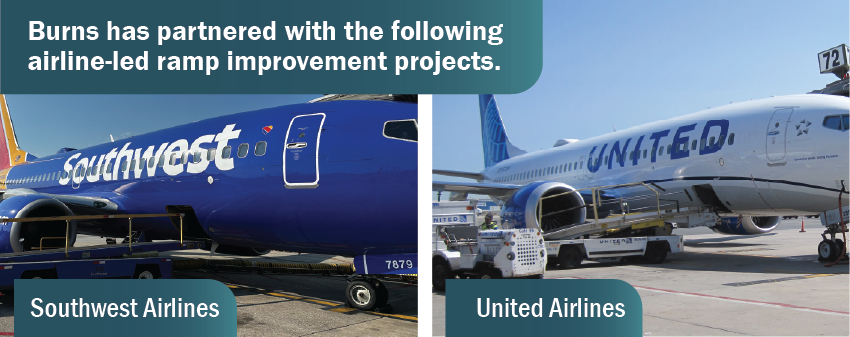
For airlines, a network-wide deployment strategy creates consistency across locations. This allows pilots, ground crews, and operations teams to follow standardized procedures regardless of airport. Standardization also simplifies training, improves adoption, and allows carriers to realize economies of scale through multi-site implementation and procurement.
Airport Operator Deployment
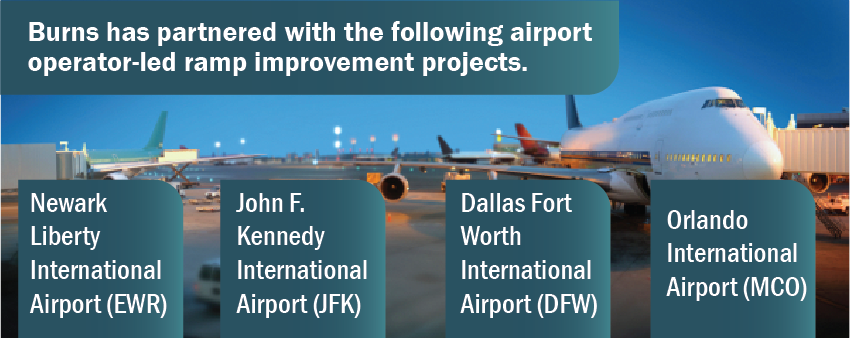
For airport operators, implementation at common-use or authority-owned gates can improve efficiency and increase the revenue potential of those gates. Systems such as VDGS and VSS software allow the operator to be more closely connected to ramp operations and better positioned to assist carrier partners in improving turn metrics.
New Construction vs Retrofitting
Ramp improvement technologies can be incorporated into new construction or retrofitted into existing terminals. New construction offers the opportunity to coordinate device placement, power, communications, structural support, and civil considerations from the beginning of design. Retrofits require careful assessment of existing conditions, gate constraints, apron circulation, mounting locations, and implementation phasing to minimize operational disruption.
In both scenarios, the value of these projects depends on thoughtful integration. The best solutions are not simply installed at the gate; they are coordinated with ramp procedures, airline operations, airport infrastructure, and long-term maintenance needs.
Emerging Technologies
As ramp operations continue to evolve, several emerging technologies are shaping the next generation of aircraft turnaround programs. These solutions build on the same goals as today’s systems: improving visibility, accelerating decision-making, and enabling more coordinated use of people, equipment, and gates.
Virtual and Remote Ramp Control
Virtual and remote ramp control is a natural evolution of today’s ramp towers. These systems can include integrated gate management, camera-based aircraft monitoring, real-time turnaround dashboards, automated alerts when milestones are missed, and centralized management of multiple concourses.
Intelligent Apron Management Software
Intelligent apron management software combines flight schedules, VDGS data, ramp cameras, airport operational database feeds, ground support equipment locations, and staffing levels. The goal is dynamic optimization of gate assignments, pushback sequencing, ground support equipment deployment, and ramp congestion.
Electrification of Ground Support Equipment
Electrification of ground support equipment, or eGSE, is one of the largest ongoing ramp investments across the industry. Examples include electric baggage tugs, electric belt loaders, electric pushback tractors, electric lavatory trucks, and electric cargo loaders. Related electrification studies for United show significant investment in charger networks, fleet management systems, battery monitoring, charging analytics, and energy resilience systems.
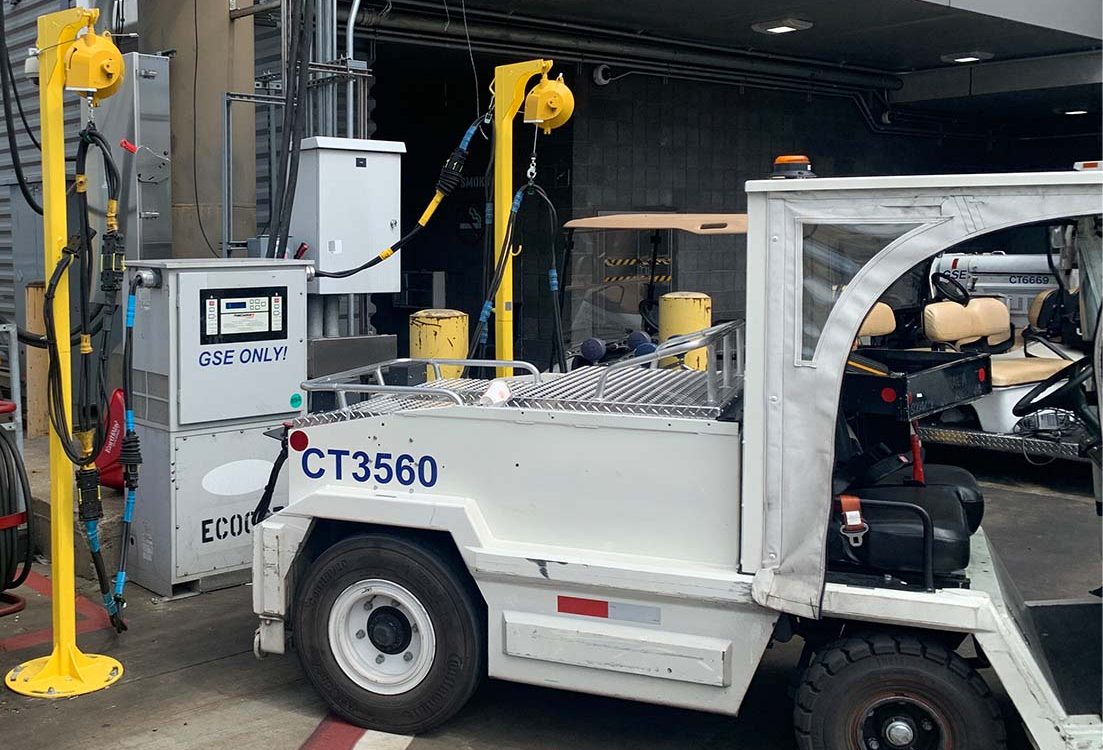
Electric ground support equipment (eGSE)
Ramp improvement projects turn existing operational pressure points into measurable performance gains. Faster and more predictable turns reduce delays, improve gate utilization, strengthen coordination among ramp teams, and support better use of capital assets. As airports and airlines face growing demands to move aircraft, passengers, baggage, and crews more efficiently, the ramp becomes a critical place to invest.
Choosing Burns gives clients a partner that understands both the infrastructure and the operational purpose behind these systems. With experience across electrical, low voltage, structural, and civil design, along with direct coordination with manufacturers and project stakeholders, Burns can help clients plan, design, and implement ramp technologies that are practical, scalable, and aligned with long-term operational goals. The result is a smarter ramp environment that supports safer operations, stronger turn metrics, and construction savings.





