

- Projects
- Insights
-
Careers

Careers
Ranked a Top Workplace and ENR Top 500 Design Firm, Burns offers opportunities to inspire, create and deliver transformational projects that last generations.
- News + Events
-
About

About
Burns inspires, creates and delivers specialized-engineering solutions for mission-critical facilities.
- Offices

-
What We Do
Discipline
Expertise
Industry-Specific - Projects
- Insights
- Careers
- News + Events
- About
- Offices

 Contact Us

"*" indicates required fields
Moving Beyond FIDS: Redefining the Value of Airport Digital Real Estate

Imagine an airport where at every turn, passengers can access the information they need precisely when they need it. A place where the digital environment works together to guide, inform, inspire, and influence. A place where every screen plays a role in elevating the passenger journey and advancing the airport’s strategic goals.
Throughout my career, digital signage has always been treated as a static template. Flight Information Displays (FIDS) with 25 rows of flight information. Baggage Information Display (BIDS) with three to five lines of upcoming bags. Gate Information Display (GIDS), wayfinding, and advertising designed within rigid content frameworks and templates that rarely spoke to one another. Each screen served its narrow function, but none contributed to a unified story. I had heard about newer technologies, such as a Digital Content Management System (DCMS), but I assumed they simply meant unified control over standard FIDS, BIDS, and GIDS templates.
What I’ve since come to understand is that the true value of a DCMS is actually in the dramatic transformation made possible by a simple mindset shift. FIDS is just one type of content, an asset no different than wait times, TSA instructions, advertising, branding, or ambient visuals. A DCMS provides its users with the ability to dynamically create and manage content across every digital surface. It’s subtle, and still overlooked by much of the industry, but content and content strategy are what distinguish a data-driven FIDS from a dynamic, experience-driven DCMS platform.
At its core, the transformation is not about DCMS itself. Technology is simply the enabler. The real change and innovation happen when airports stop thinking in terms of legacy systems, and start thinking in terms of content strategy. In doing so, content management embodies a fundamental shift from simply operating screens, to orchestrating an integrated digital experience that responds to context, audience, and opportunity.
Once a content strategy mindset takes hold, digital displays evolve from operational tools into strategic assets that advance the airport’s visual communication power, turning content and digital real estate into an active force that shapes behavior, drives engagement, and amplifies the airport’s brand presence.
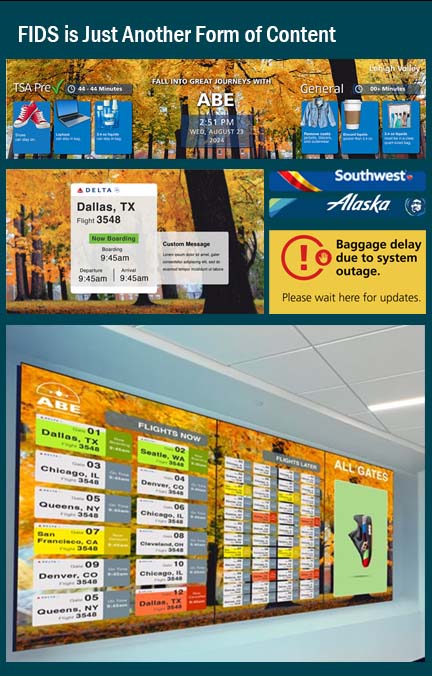
Examples of different content assets, provided courtesy of Synect
Why Visual Communication Matters
Visual communication is the most immediate and universal language an airport speaks. Step into any airport in the world and you’ll see the same choreography unfolding: travelers scanning their surroundings for information, searching for signs, screens, or cues to tell them where to go next. For most passengers, every decision from check-in to boarding is guided not by staff or announcements, but by what they can see and interpret in the environment around them. Airports speak to their passengers visually long before a word is ever said.
Today, this visual language even extends beyond the physical world. Passengers now move through airports with another screen always in hand. Phones are a passenger’s personal flight companion, wayfinding guide, and connection to the airline. Boarding passes, gate changes, restaurant suggestions, and push alerts all seemingly compete for attention against airport displays.
Every second a passenger spends looking at a screen is a valuable opportunity to inform, engage, or influence. In an airport, that attention can translate to smoother operations, stronger brand connection, increased revenue, and the kind of positive social presence that shifts public perception from “I hate flying through here” to “That was actually a great experience.” The challenge is that attention is finite and fragmented. Passengers are constantly deciding which source of information to trust: their phone, an airline email, or the nearest display.
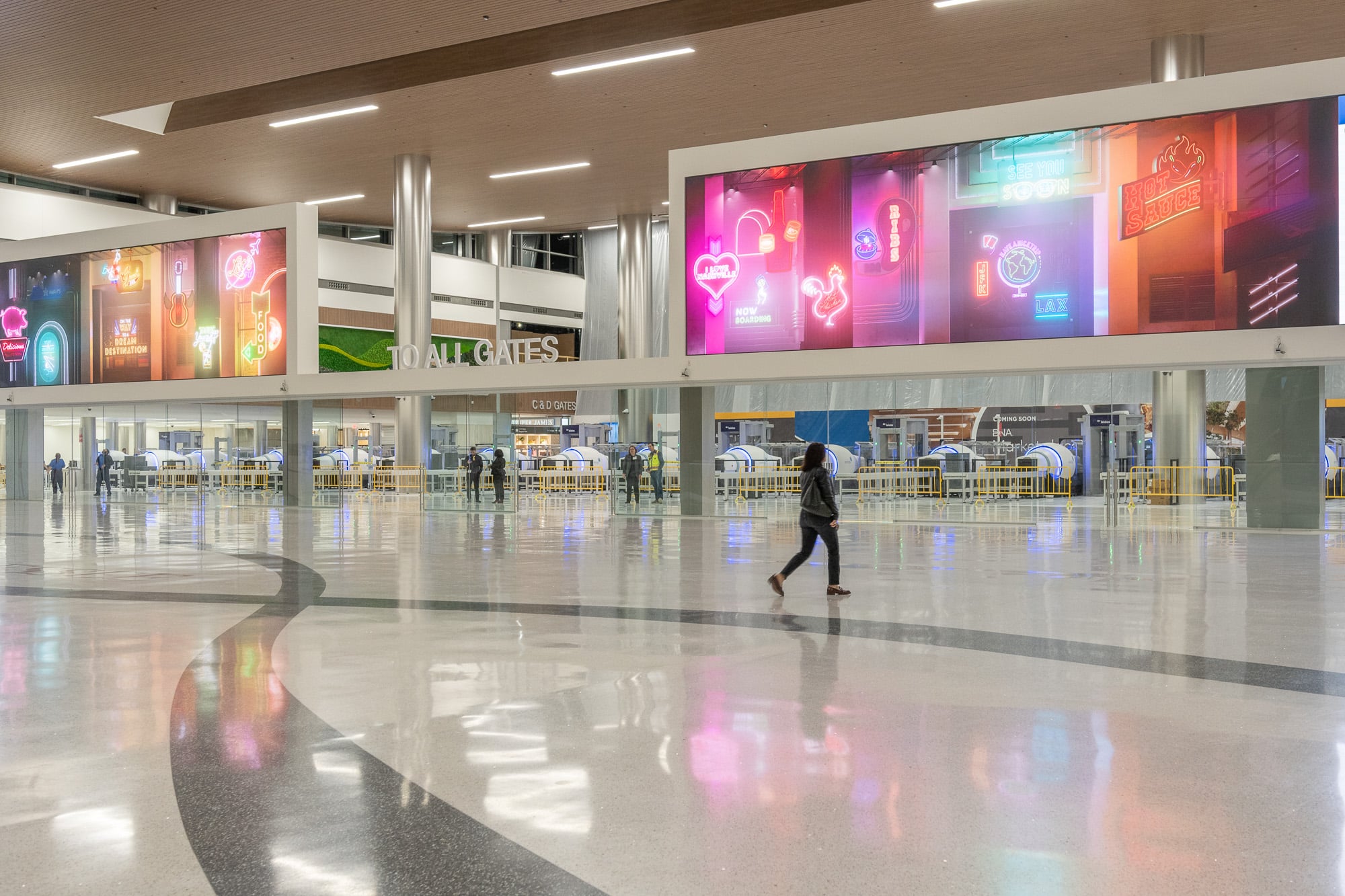
Immersive digital displays in the Grand Lobby at Nashville International Airport / Photo courtesy of Maxime Roux/Gentilhomme Studio
Of all the platforms competing for a passenger’s attention, only one truly belongs to the airport: its own digital information and physical displays. Phones and airline apps are outside the airport’s control, but the visual environment is not. Every pixel of digital real estate is an opportunity to claim a share of that attention and turn it into something meaningful. When used strategically, the digital environment becomes the airport’s most powerful tool for transforming attention into measurable value, serving as a catalyst for other innovation opportunities such as using data analytics for context aware content, or transferring content onto the passenger’s mobile device.
The Value of Digital Real Estate
Every airport sits on one of the most valuable yet underutilized assets in the industry: digital/visual real estate. Each screen, ribbon, and display location represents not just a communication point, but a piece of property within the passenger journey. In most cases, this property and infrastructure already exist in the airport, just waiting to be used more strategically.
Advertisers already understand this. They analyze sightlines, calculate impressions, and bid accordingly. Advertisers spend billions each year to capture attention in airports because the dwell time, audience quality, and brand impact are unmatched in almost any other public environment. Airport audiences are among the most valuable in media: captive, high-intent, and highly trackable. A single display can reach thousands of passengers per hour, meaning the effective revenue-per-square-foot of digital media often exceeds that of traditional retail space.
What’s remarkable is the investment and effort that advertising operators are making to position their assets in can’t miss, prime locations. They market heavily to advertisers that the ads are un-skippable media, enabling them to charge premium rates. Similarly, airport screens are natural visual anchors and are already also positioned in these prime locations. People are drawn to them out of necessity; they are designed to be looked at. When you juxtapose the value advertisers invest in capturing attention against the attention that airport displays already command, the significance of the content strategy becomes undeniable.
Advertising operators responsible for selling, scheduling, and maintaining airport media increasingly recognize the value of alignment as well. Many are eager to collaborate with airports and their stakeholders to create unified content strategies that reduce digital clutter, prevent conflicting messages, and allow valued brand partners to connect with passengers in a more meaningful and authentic way at sensitive touch points of the passenger journey.
Despite this clear value, airports often overlook the opportunity they have. Walk into any airport and you’ll see screens half-filled with placeholder flight rows, departures and arrivals listed hours before they matter, empty bag-claim displays running as background wallpaper, and messaging that hasn’t been updated in months or even years.
The average passenger spends 60 to 120 minutes inside the airport after clearing security. This creates a strategic tension: flight information is necessary, but rarely urgent at that stage of the journey. The question becomes, “How should airports use this time?” This is high-quality, high-attention time when passengers are actively deciding where to go, what to do, and how to spend their time before boarding. Do they fill the screens with data passengers won’t need to act on for another hour? Can they optimize the highly valuable real estate and shift some of that information to less valuable, more flexible, personal channels like QR codes and phones? And, most importantly, how can airports use these moments to shape how passengers navigate and experience the terminal?
These are the moments when airports can influence. The moments where a screen can guide a passenger to food, retail, art, amenities, or simply a more comfortable space. When screens default to flight data long before it’s needed, passengers naturally become gate huggers, settling at the gate because the environment gave them no reason to go anywhere else. When displays are used intentionally, they become a form of gentle wayfinding, nudging passengers toward exploration rather than waiting. Displays can highlight local culture, surface real-time dining availability, and simply remind travelers that the airport experience extends beyond the seats next to their gate.
Traditionally, operational and commercial screens have lived in separate worlds. FIDS and wayfinding are viewed as functional necessities, while advertising is treated purely as a revenue stream. Yet to passengers, it’s all one visual environment—complicated further by the screen they carry in their hand. When airport displays, advertising, and phone screens are not aligned, all three compete for attention, and the effectiveness of each is diminished.
Example of award-winning integrated advertising content strategy via Clear Channel on LinkedIn
The Cost of Content Strategy: The Hollywood Burbank Story
Once my understanding of digital displays shifted from screen management to experiential platform, I knew I had to bring this approach into one of the airport projects my team at Burns was supporting: the Elevate BUR: Hollywood Burbank Airport Replacement Passenger Terminal, scheduled to open in October 2026. Situated in the Media Capital of the World, the airport was uniquely positioned to pioneer a digital strategy that integrates the region’s creative economy directly into the transportation experience.
Burns had been part of the project since the Concept of Operations phase, and by the time this realization clicked, the design was already about 90% complete. The Guaranteed Maximum Price was in place, the scope was defined and locked, and most decisions were considered final. Any changes would result in an expensive change order.
Walking in at that stage with a proposal to rethink the entire signage strategy was not the easiest conversation to start. It took months of considering how to introduce the idea, how to time the discussion, and how to ensure it would be received as an opportunity rather than a disruption.
Naturally, my proposal was met with resistance, and I understood why. This was a new approach, and with anything new comes uncertainty: questions about risk, cost, responsibility, and precedent. It wasn’t that the team disagreed with the vision; it was that the project was already late in design, the schedule was tight, and no one wanted to introduce something that might destabilize what was already in motion.
What we discovered over many months of discussion was that this wasn’t about adding something new. The project already included traditional FIDS and wayfinding — they are essential to airport operations. Which meant the budget for digital displays was already in the project; the real question was simply how that budget would be used.
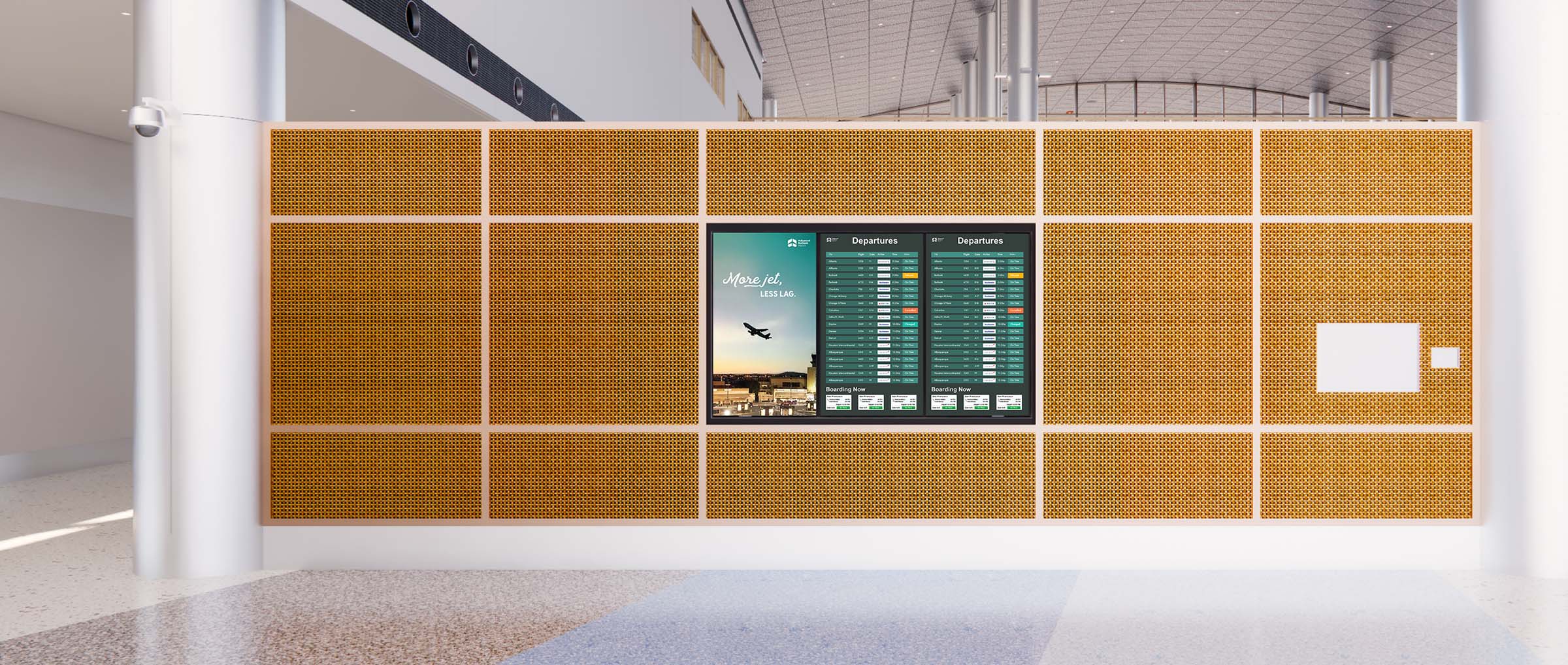
BUR Board original design concept / Rendering courtesy of Corgan / Content courtesy of Synect
Instead of asking, “Do we add DCMS?”, the question became, “How do we use the displays and Electronic Video Information Display Systems (EVIDS) infrastructure we’re already paying for to deliver a better passenger experience?” That shift opened the door to evaluate DCMS alongside the existing scope — not as an addition, but as an alternative approach to delivering the same operational requirements with far greater strategic value. This evaluation became a turning point in determining the future direction of the airport.
The surprising outcome was that the DCMS-led content strategy didn’t add scope or cost. Instead, it streamlined the effort and created savings within the existing budget. Before the DCMS evaluation, by defaulting to legacy systems, the project was actually planning to spend more while losing the opportunity to introduce a cohesive content strategy, a true content-management framework, and an experiential vision supported by a partner equipped to deliver it. With Burns’ innovative approach, the airport was now in a position to select a partner capable of delivering this experiential, next-generation platform and retain a surplus of funds.
“This was the moment Hollywood Burbank Airport chose to move beyond FIDS.”
This rare and meaningful collaboration was an unprecedented win for the entire project team. The airport and design-builder were able to mutually identify a strategic location to apply the savings and Elevate BUR’s FIDS without disrupting schedule or budget. At the critical moment just after passengers clear security—when they are orienting themselves and deciding where to go next—we transformed the traditional data-feed FIDS into two large, highly dynamic direct-view LED displays that could do far more than list flights. These displays are sized and positioned where every passenger encounters them, presenting maps, branding, art, advertising, and dynamic content alongside elevated, context-aware flight information.
By placing these displays at the moment of orientation, we shifted the dynamic of passenger movement. Instead of heading straight to the gate, travelers are encouraged to explore the airport— discovering food, retail, art, and space to relax with clarity and confidence.
Hollywood Burbank is surrounded by some of the largest studios and content creators in the industry. These displays provide a new canvas for the airport to express identity through short-form narrative, motion design, and place-based storytelling tied to major regional and global moments. For Hollywood Burbank Airport, this is a once-in-a-lifetime moment to showcase the creative capital of the region on a platform that millions will experience as the world arrives in Los Angeles for the LA28 Olympics.
The platform also opens the door for advertisers who share this experiential vision — not just traditional billboard buyers, but brands that see themselves as contributors to cultural experience. The result is a digital environment that guides movement, reflects the essence of Burbank, supports the region’s creative economy, and engages passengers through content that feels meaningful, contextual, and alive.
Content Strategy: The Future of Airport Digital Real Estate
Airports are no longer simply transportation hubs; they are cultural gateways and brand environments. The identity of an airport is shaped not only by its architecture, amenities, or art program, but by the way it communicates visually every moment a passenger moves through it. Screens, displays, and digital surfaces are now as fundamental to the experience as signage, lighting, or spatial planning. They reflect what the airport values, how it guides movement, and how it presents itself to the world. As passenger expectations continue to evolve, visual communication becomes a defining element of the airport’s identity.
We’re standing at the edge of a major opportunity. Airports are under pressure — budgets are tight, passenger expectations are rising, and technology is moving faster than traditional design cycles can respond. But the solution isn’t to reinvent the wheel. The infrastructure is already being built. The partners already exist. The capability is already here.
“The screens are already in the airport. What needs to change is how we think about and use them.”
At Hollywood Burbank Airport, the Burns team demonstrated that an innovative, experience-driven digital platform buoyed by an emphasis on content strategy can be delivered within an airport’s established budget. By reframing the role of FIDS, the airport advanced its Elevate BUR vision and aligned its digital environment with the creative identity of the region. The result is a coordinated visual ecosystem that shapes what passengers see, how they move, and how they remember their experience at the airport. The lessons from Hollywood Burbank reveal how any airport can use content strategy to reflect its community, strengthen its identity, and redefine the travel experience.





