

- Projects
- Insights
-
Careers

Careers
Ranked a Top Workplace and ENR Top 500 Design Firm, Burns offers opportunities to inspire, create and deliver transformational projects that last generations.
- News + Events
-
About

About
Burns inspires, creates and delivers specialized-engineering solutions for mission-critical facilities.
- Offices

-
What We Do
Discipline
Expertise
Industry-Specific - Projects
- Insights
- Careers
- News + Events
- About
- Offices

 Contact Us

"*" indicates required fields
Harmony on the Rails: Recovering Performance Following Safety Mandated Compliance on the Northeast Corridor


For rail operations on the Northeast Corridor (NEC), safety and performance have always been discordant. While the safest train is a stopped train, no railroad can operate to serve its customers by slowing and stopping unnecessarily. The friction between these operational elements was intensified following the Rail Safety Improvement Act of 2008 and the Federal Railroad Administration’s (FRA) mandate[i] to implement Positive Train Control (PTC)[ii] on an aggressive schedule with limited dedicated funding.
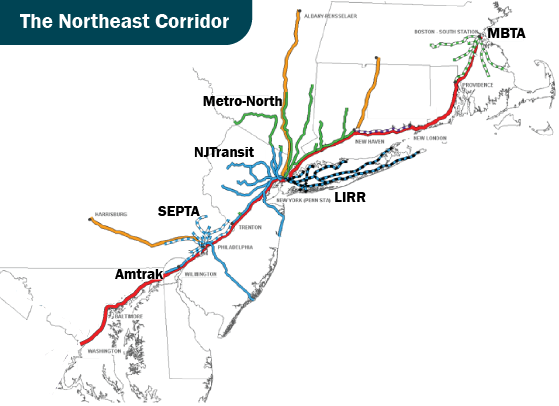
Under non-negotiable regulatory pressure and tight timelines, NEC commuter railroads turned to the Advanced Civil Speed Enforcement System (ACSES)[iii] that was already in use on the corridor by Amtrak to allow operating speeds greater than 125 mph and already included the core functionality to satisfy the FRA’s PTC mandate. The migration of ACSES onto some of the most complex and heavily utilized railroads in North America was not a seamless solution. Implementation occurred on live infrastructure, layered over legacy signal systems, aging wayside assets, and existing operating rules. Railroads had to develop requirements and adaptations of the system to meet their individual operational needs, while remaining backwards compatible and interoperable with the tenants of their system. Because the mandate required results and not refinement, design choices favored certainty and enforcement over optimization.
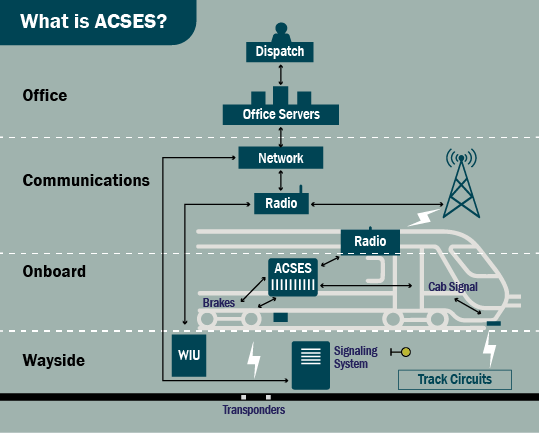
By 2020, NEC railroads achieved PTC compliance. In some cases, this involved conditions, but there was a clear outcome: trains were safer. While compliance marked the end of one phase, it is not the end of the challenge. ACSES, like all fail safe systems, is inherently conservative. When required information from the system is missing, degraded, or inconsistent, the system responds by restricting speed or stopping the train, shifting risk from safety to operations.
Today, the NEC’s most important operational question is no longer how to comply, but how to operate better within a compliant system. The safety foundation is in place. The next gains will come from reducing avoidable enforcement events by improving data reliability and integrity to minimize the operational impact of failures that cause trains to slow or stop; not because conditions are unsafe, but because the system lacks sufficient information to confirm they are safe.
Recovering Performance
While there are several ways to reduce these avoidable enforcement events, one function that brings about operational benefits and sets up the system for future incremental improvements is the introduction of a database into the ACSES onboard controller that will contain ACSES track and asset information.
Currently, the ACSES system relies on reading static transponders. This functions like an EZPASS on an automobile but gives much more information including a train’s current location, any approaching speed restrictions, and radio information for requesting dynamic information for upcoming track conditions. The onboard controller uses this information to automatically enforce braking when a train exceeds safe operating speed limits, including exceeding a profile to approaching speed or stop conditions. Transponders can be missed, or misread, due to a range of issues, such as damaged equipment (the transponder, or the under-train scanner antenna), environmental conditions (snow or electrical interference), misplacement by maintenance during track work, or vandalization.
The train continues in a degraded mode of operation until it reads the next transponder set where it can return to normal operating speeds based on restoring its location and track information. The distance between transponder sets, while typically a few thousand feet, can be two miles, both of which can result in time delays to the operating schedule.
The introduction of an onboard database supplements the transponders on the ground by providing a secondary source of information when a transponder is not successfully processed. This allows the train to continue operating at a normal operating speed as the onboard can retrieve the same information that was in the transponder from its internal database.
Experienced Implementers
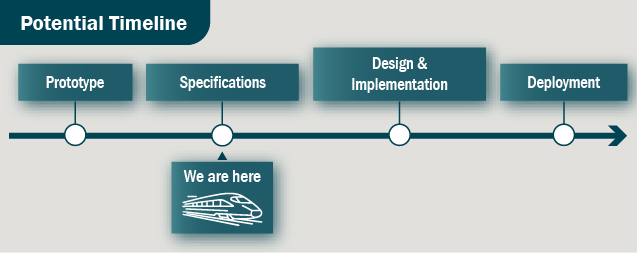
Burns has demonstrated the viability of this database concept with an ACSES supplier on a passenger railroad and remained actively engaged with NEC rail authorities to advance solutions that preserve safety while reducing operational impacts. Together, that experience positions Burns to help move the solution from proof of concept to interoperable implementation across the corridor. As part of that proof-of-concept, there were a few failure modes, operational situations, and operational process needs that needed to be further defined for a fully functioning solution. These specifications are actively being worked on currently and being coordinated at a high-level with all NEC ACSES railroads to ensure interoperability.
The solution is likely to require a small update to the existing hardware onboard to support the increased processing needs and interfaces for receiving database updates, along with modifications to existing protocols for verification that the proper database is installed on the train prior to departure. Additionally, there will need to be a process to ensure safe generation of the database, aligned with the ground-based transponders, and manage the update of data to trains whenever a change to infrastructure occurs.
Because time is a major factor in upgrading ACSES fleets, once one NEC authority begins to implement the solution, a phased approach would be needed to deploy the database across the NEC while still allowing existing technology to operate. Only trains equipped with the database solution would reap the benefits of having the ground information when missing a transponder.
Key challenge areas for implementation:
- Configuration management of the database and trains
- Distribution of the database when updates occur (to trains and other authorities)
- Data revision and data corruption checks with associate failure modes.
- Processing needs and space for new equipment on trains
Key Benefits:
- Significant reduction in operational impacts due to failed transponders
- Minimal impact on system modifications and safety methods
- Platform established for future enhancements, such as enhanced routing information through an interlocking (more refined asset information)
- Potential reduction in ground-based transponder infrastructure once all fleets are updated, which also results in quicker data updates when rail infrastructure changes occur.
 Ultimately, implementation of the ACSES system on the NEC has allowed railroads to meet PTC regulatory requirements and has successfully improved the safety of the railroad. The challenge the NEC now faces is to maintain that level of safety while improving the system performance. By modifying the existing system to incorporate the transponder information into a database, the operational slowdown due to loss of transponder information can be mitigated. Modifying the database to a more than 25-year-old technology also demonstrates the flexibility of the ACSES system to integrate incremental improvements without the need to refactor the entire railroad investment already put in place. Once a database is put in place, railroads will have the mechanism to update infrastructure information changes to ACSES quicker and reduce future maintenance costs through a reduction in the number of ground-based assets.
With staff experience dating as far back as the initial ACSES design and deployment in the late 1990’s, the Burns team understands the inputs into the system, the resulting functionality and the underlying safety methodologies to ensure safe operation. This puts us in a unique situation to identify new ways to define enhancements to the system while maintaining the core functional needs of this process:
- Develop conceptual paper(s) for internal alignment within the railroad and gain alignment with other NEC ACSES railroads for interoperability.
- Provide the system integration services between railroads and suppliers to implement the solution.
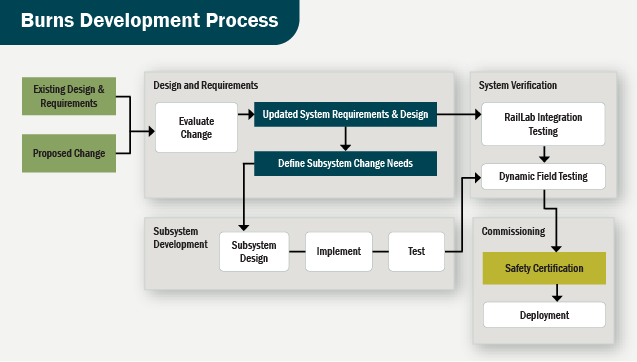
- Qualify the updates in our RailLab environment where we simulate performance at an ACSES system level.
- Provide final qualification of system updates through test train operation.
- Coordinate with suppliers and the railroad for regulatory compliance needs and updates to safety documentation and configuration management of the system.
We are really excited about the opportunity to improve a rail system our engineers have been intimately involved with both before joining the firm and throughout their time here. Achieving operational harmony on the NEC— improving system performance for railroads and their passengers while also maintaining safety—aligns perfectly with the kind of complex, meaningful challenges our engineers are motivated to solve.
____________________
[i] The mandate for PTC includes four high-level requirements:
- Prevent train-to-train collisions; primarily enforced by ATC.
- Prevent overspeed derailments; enforced by ACSES.
- Prevent unauthorized incursion into established work zone limits; enforced by ACSES.
- Prevent movement through a main line switch in the improper position (I.e., Enforcement of red signal stops); primarily enforced by ACSES as an overlay on ATC.
[ii] PTC (Positive Train Control) is the combination of traditional signaling, or automatic train control (ATC), which enforces proper train separation, and ACSES (Advance Civil Speed Enforcement System) which enforces train speed limits through profiles to targets in advance (ahead) of the train.
[iii] ACSES provides for automated speed enforcement on trains by initiating brakes when the train exceeds safety thresholds for safe train operation. The system receives information from the wayside (device installed trackside and within the gauge of the track) to know both static speed limit information and dynamic signal information at interlocking locations (where the train can change tracks).





