

- Projects
- Insights
-
Careers

Careers
Ranked a Top Workplace and ENR Top 500 Design Firm, Burns offers opportunities to inspire, create and deliver transformational projects that last generations.
- News + Events
-
About

About
Burns inspires, creates and delivers specialized-engineering solutions for mission-critical facilities.
- Offices

-
What We Do
Discipline
Expertise
Industry-Specific - Projects
- Insights
- Careers
- News + Events
- About
- Offices

 Contact Us

"*" indicates required fields
Efficiently Delivering Ambulatory Surgical Centers


For hospital systems, physician groups, and healthcare developers, ambulatory surgery centers (ASC) offer a faster, more accessible way to deliver outpatient procedures. They can expand care into new markets, reduce pressure on hospital operating rooms, and create a more convenient experience for patients. ASC projects begin with a fixed budget and an aggressive timeline. If the project follows a traditional design-bid-build path, owners may not know whether the design aligns with their budget until months into the process. By then, changes can mean value engineering, redesign, schedule delays, or difficult funding decisions.
Owners and decision-makers need to hire consultants that understand that ASC’s are not just “small hospitals.” While they still require healthcare-grade compliance, these facilities need right-sized, practical solutions.
That means planning for state and regulatory compliance; addressing infection control and ICRA requirements; coordinating phased construction; and right-sizing procedure rooms, imaging spaces, MRI and CT suites, hybrid ORs, oxygen, generator, and other critical systems. It also means designing simpler, turnkey systems that support day-to-day operations without assuming that the center will have full-time maintenance staff on site.
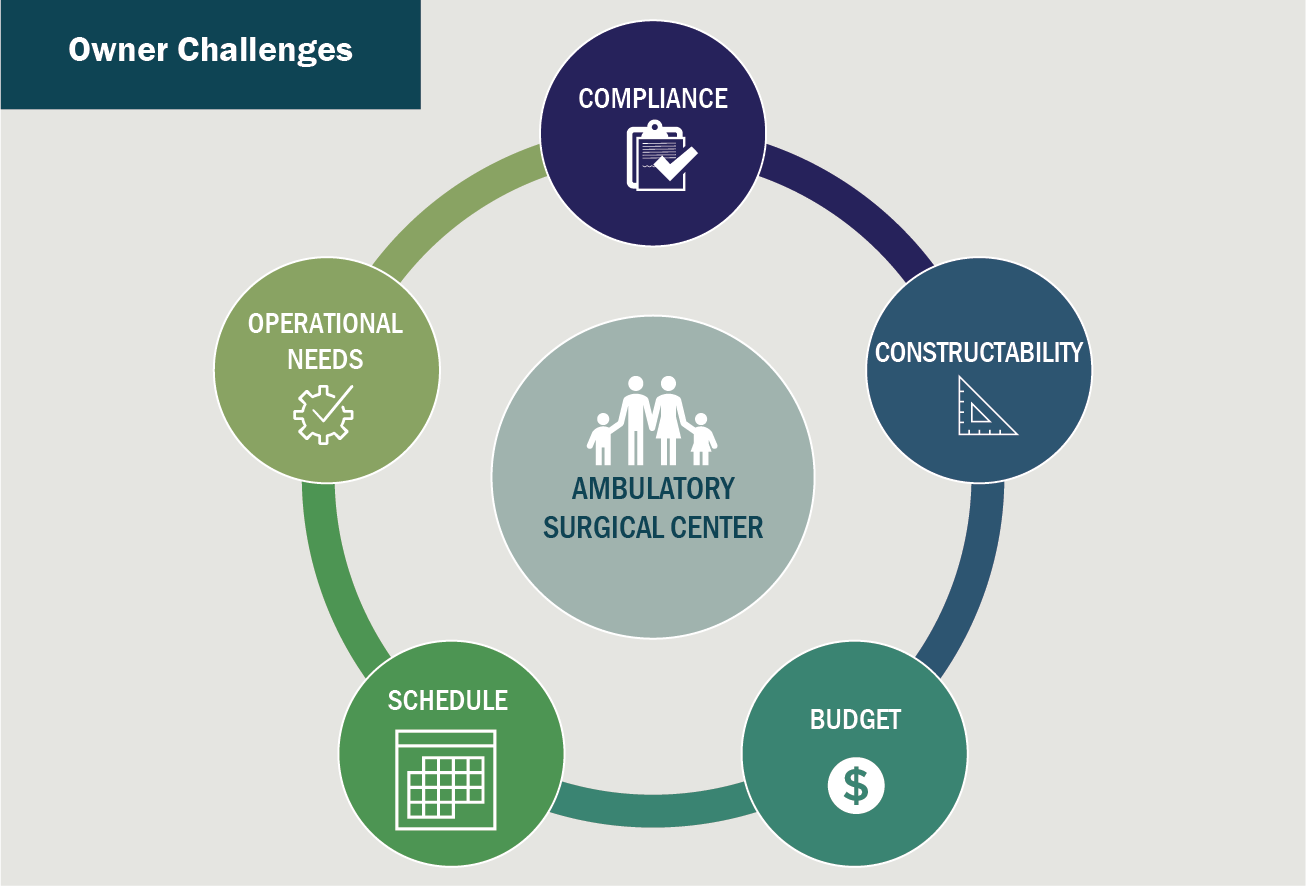
This is why Burns favors an integrated approach to surgical center project delivery, using in-house engineering and construction management teams. Under this model, owners and decision-makers get real-time pricing insight throughout design. Instead of designing first and pricing later, our teams help clients understand cost, constructability, schedule, and regulatory implications as decisions are being made. That early visibility is especially important for ambulatory surgical centers, where speed to market, right-sized systems, regulatory compliance, and budget discipline must be aligned. Our practical designs avoid overbuilding and provide a faster path to funding and construction readiness.
Our extensive experience with integrated delivery for ASCs include:
- A physician group affiliated with a hospital that wanted its own ASC to gain more control over scheduling and patient throughput.
- A client considering expansion from four to five procedure rooms who needed real-time pricing before committing.
- A healthcare owner who needed early schematic pricing to support funding or banking approval.
- A phased ASC project that required infection control measures while some rooms were brought online before others.
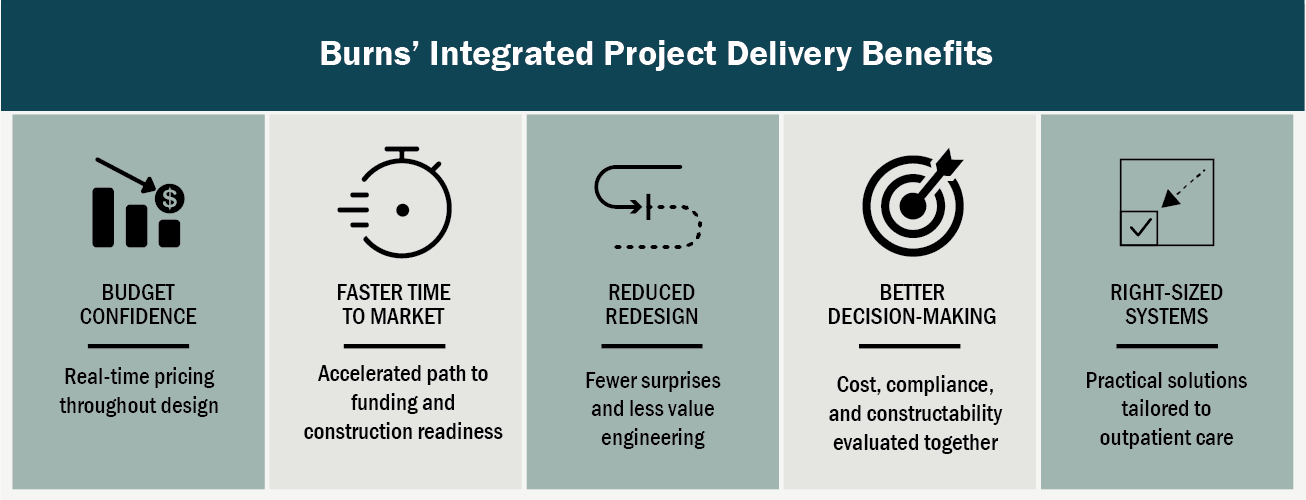
The greatest benefit of Burns’ integrated approach to surgical center project delivery is that it shifts the project from a reactive process to a proactive one. By encouraging the construction management team to work hand in hand with the design team from the earliest stages of the project, key decisions related to budget, constructability, logistics, phasing, and schedule can be evaluated while the design is still flexible and cost effective to modify. This collaborative approach is particularly valuable for surgical center projects, where complex building systems, medical equipment coordination, infection control requirements, and facility operations considerations must all be carefully integrated. Leveraging both the design team’s expertise and the construction team’s real-world experience allows potential challenges to be identified and resolved early, reducing risk, minimizing costly changes during construction, and improving overall project delivery. Most importantly, it provides the client with a clear expectation of project scope, budget, schedule, operational impacts, before construction begins, creating greater confidence and predictability throughout the project.

Related Insights





