

- Projects
- Insights
-
Careers

Careers
Ranked a Top Workplace and ENR Top 500 Design Firm, Burns offers opportunities to inspire, create and deliver transformational projects that last generations.
- News + Events
-
About

About
Burns inspires, creates and delivers specialized-engineering solutions for mission-critical facilities.
- Offices

-
What We Do
Discipline
Expertise
Industry-Specific - Projects
- Insights
- Careers
- News + Events
- About
- Offices

 Contact Us

"*" indicates required fields
Navigating a New World Order: Understanding the Current Reality of Procuring Equipment for Higher Education Projects


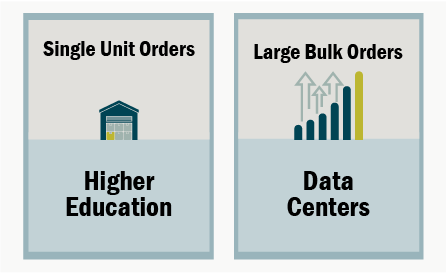 For decades, elite higher education institutions have been accustomed to operating from a position of priority in the construction marketplace. Typically, large campuses with steady capital programs commanded attention from manufacturers and suppliers, but today, that dynamic has shifted. The rapid expansion of data centers and artificial intelligence infrastructure has fundamentally changed demand for critical building equipment. Our clients in the data center market are ordering switchgear, transformers, generators, and chillers 50 at a time, years in advance, for just one project. Manufacturers are prioritizing the massive orders tied to these projects, and, as a result, institutions that may need only a single transformer, air handler, or switchgear are finding themselves competing in a very different market.
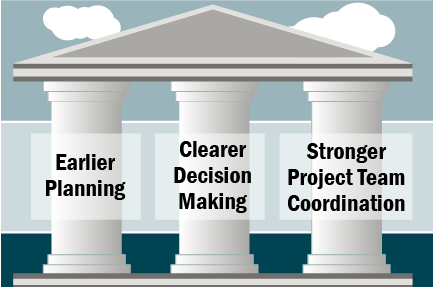
The implication is clear: equipment procurement timelines in traditional construction are growing longer and less predictable. Navigating this environment requires earlier planning, clearer decision-making, and stronger coordination across the project team.
Burns is using several strategies to help higher education institutions manage this evolving landscape.
Discuss Design Challenges Early
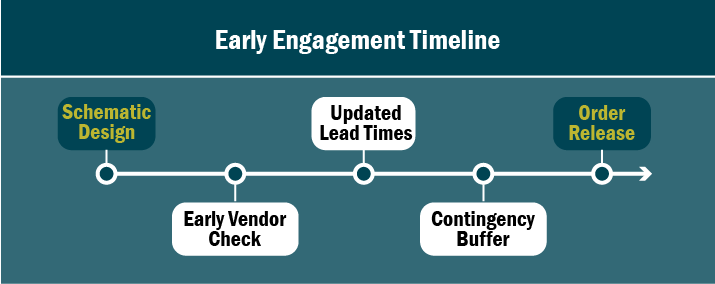
One of the most important strategies is addressing potential procurement challenges at the very beginning of a project. During schematic design, engineering teams should raise the issue of equipment lead times directly with stakeholders.
This early conversation helps ensure everyone understands that procurement timelines may extend well beyond their historic experiences. Establishing these expectations upfront allows the project team to plan around them rather than react later.
Equally important is engaging manufacturers and vendors during this early phase. While lead times may still shift, vendors can often provide current estimates. Sometimes, this means indicating timelines of two years or more for certain equipment. Project teams should build in contingencies beyond these estimates to account for market volatility.
Identify Non-Negotiables
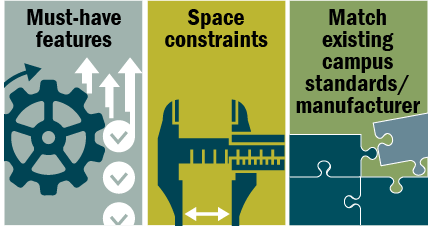 Early design discussions should also focus on identifying the project’s true requirements. Three specific questions should be answered during schematic design:
- Are there specific equipment features that cannot change?
- Are there space limitations that require a particular configuration?
- Do you have a system or manufacturer on campus you are trying to match?
Clarifying these factors during schematic design allows engineers to design around confirmed constraints from the outset. Waiting until later phases to determine these details can create major redesign challenges, especially if the equipment ultimately selected has unique spatial or infrastructure requirements.
Consider Pre-Purchasing Critical Equipment
When the institution already knows exactly what equipment it wants—such as replacing existing systems in kind—pre-purchasing can be an effective strategy. In these situations, the institution procures the equipment early in the process while design continues. This approach allows the lead time clock to start immediately, rather than waiting until construction documents are complete.
Burns is currently working with multiple Higher Education clients that have modified their traditional procurement. They are procuring equipment directly or through a CM in early phases of the design, sometimes even as early as schematic design phase for unique equipment.
Not every project or procurement process allows for this strategy, but when it is feasible, it can significantly reduce schedule risk.
Use Phasing and Temporary Systems to Maintain Operations
Higher education campuses are complex environments where shutdowns must be carefully coordinated around academic calendars, research activities, and residential occupancy. Project teams often work closely with facilities staff to identify acceptable shutdown windows and seasonal constraints. From there, engineers can develop phasing strategies that minimize operational disruption.
In some cases, temporary equipment may be required to bridge the gap while waiting for permanent systems to arrive. While this approach adds cost and may be aesthetically unpleasant, it allows construction to proceed and ensures campus operations remain functional rather than delaying projects indefinitely.
Engage Construction Managers Early
Construction managers can be valuable partners during design because of their direct exposure to current procurement realities. Unlike design teams that may rely primarily on vendor conversations, construction managers are often sourcing equipment across multiple projects and suppliers simultaneously. This gives them real-time insight into what lead times look like in the field.
Bringing construction managers into the process early allows project teams to validate assumptions, refine schedules, and identify alternative strategies if certain equipment becomes unavailable.
Keep the Design Phase Focused
Lengthy design schedules can unintentionally create additional risk in a volatile equipment market.
The longer a project remains in design, the more likely that lead times, equipment availability, or manufacturer constraints will change. Keeping the design phase focused and efficient helps ensure that the procurement assumptions made early in the project remain relevant when orders are ultimately placed.
This also reinforces the importance of timely decision-making by project stakeholders. Adjustments are always possible, but frequent changes can have significant schedule implications in today’s supply environment.
Leading Clients Through a Changing Market
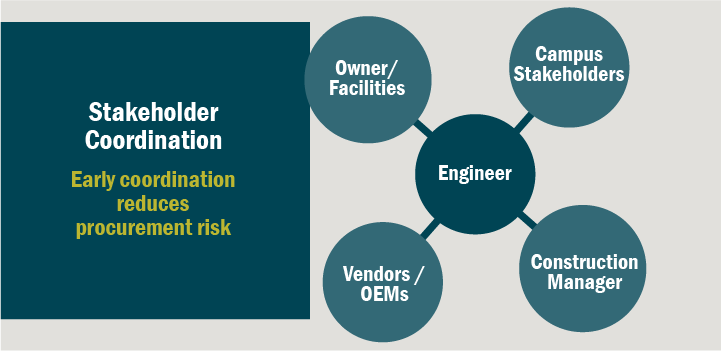
Ultimately, managing extended equipment lead times comes down to planning, communication, and early alignment among stakeholders.
Burns understands our team’s role in guiding clients through this process. We raise challenges early, help institutions make decisions sooner, and coordinate closely with vendors and construction partners.
The market conditions may have changed, but with proactive planning and a collaborative approach, higher education institutions can still successfully deliver the infrastructure upgrades their campuses depend on. Our expert teams are ready to help you navigate this new world order.





