

- Projects
- Insights
-
Careers

Careers
Ranked a Top Workplace and ENR Top 500 Design Firm, Burns offers opportunities to inspire, create and deliver transformational projects that last generations.
- News + Events
-
About

About
Burns inspires, creates and delivers specialized-engineering solutions for mission-critical facilities.
- Offices

-
What We Do
Discipline
Expertise
Industry-Specific - Projects
- Insights
- Careers
- News + Events
- About
- Offices

 Contact Us

"*" indicates required fields
Powering Modern Data Centers: Infrastructure Realities & Technology Pathways


Data center power delivery is at a breaking point. Driven by artificial intelligence, high-density computing, and hyperscale expansion, electrical infrastructure has become one of the primary constraints on speed to market. Utility-centric delivery models still matter, but they are no longer sufficient by themselves in regions where available capacity, interconnection timing, and equipment lead times are already stretched.
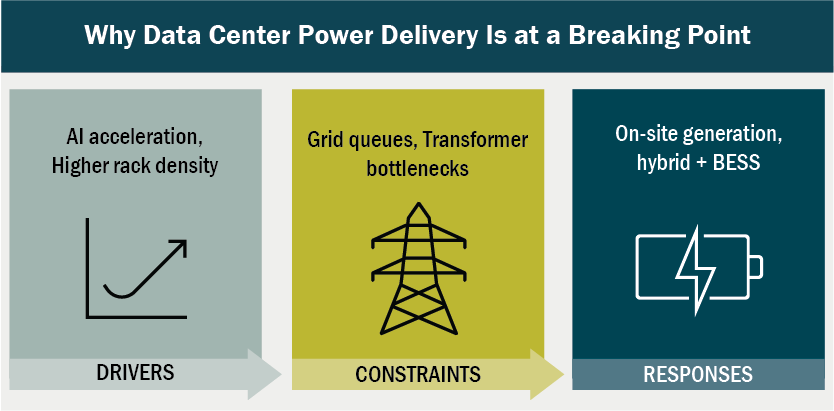
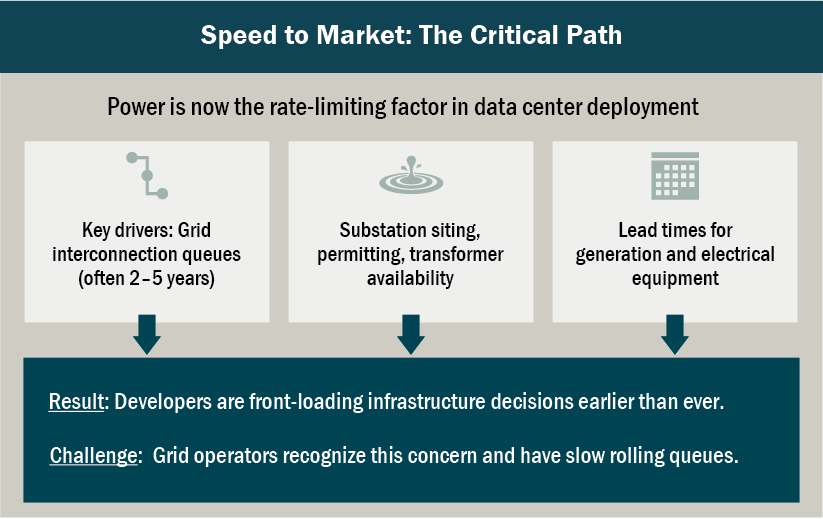
Now, power planning must begin during site selection, not after the building program is defined. Grid interconnection queues, substation capacity, transmission upgrades, transformer availability, medium-voltage switchgear, protection systems, and permitting can all control the critical path. As a result, owners need to evaluate multiple power pathways early, including permanent utility service, dedicated substations, phased electrical infrastructure, energy storage, and temporary or permanent on-site generation.
Partnering with a firm that understands both utility infrastructure and Original Equipment Manufacturer requirements is essential. Burns helps clients compare power delivery options through the lens of availability, lead time, constructability, operating flexibility, and regulatory risk so the selected strategy supports both near-term deployment and long-term facility performance.
Electrical Infrastructure Options
Traditional data center development has typically treated the utility interconnection as the primary source of normal power, with the facility design organized around redundant utility feeds, dedicated substations, medium-voltage distribution, UPS systems, standby generation, and phased white-space deployment. That model remains effective where utility capacity is available on the required schedule. It becomes less reliable when the interconnection timeline is longer than the customer’s required in-service date.
The practical issue is sequencing. A site may be ready from a land, entitlement, fiber, and building perspective while still waiting on utility studies, transmission upgrades, substation expansion, major electrical equipment, or environmental approvals. In that environment, power is not a downstream design item. It is a front-end development constraint that determines whether a project can be energized in phases, held for a future utility milestone, or supported through an interim power strategy.
A blended power strategy addresses that constraint by treating utility interconnection, battery energy storage, and on-site generation as coordinated elements of one electrical architecture. Storage can support ride-through, power quality, fast response, black start support, and operating flexibility. On-site generation can provide dispatchable capacity during the bridge period before full utility service is available. The permanent utility interconnection remains the long-term anchor, but the project is no longer dependent on a single energization milestone to begin serving load.
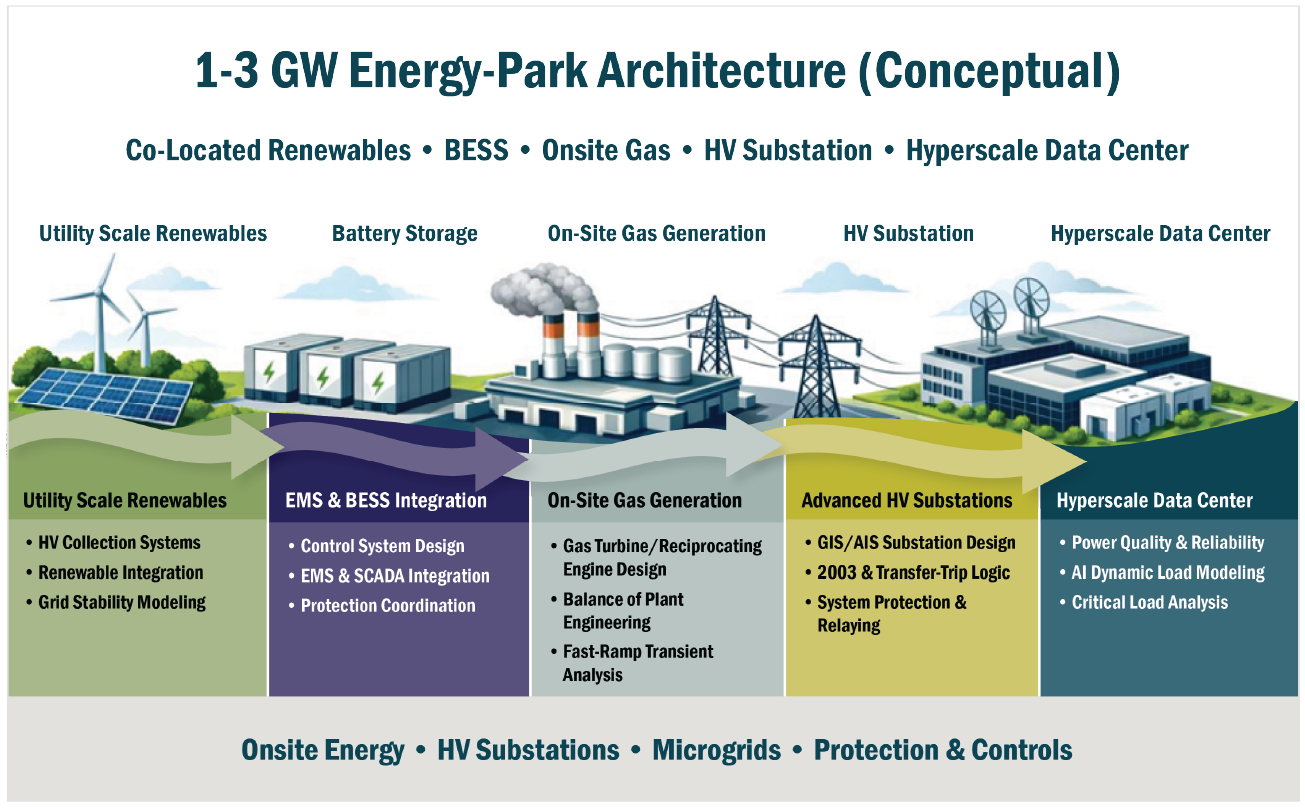
When designed as an integrated system, this approach can bridge short-term and long-term power needs without compromising schedule, reliability, or efficiency. Early phases can be energized with a right-sized combination of generation, storage, and medium-voltage infrastructure while permanent interconnection and substation work proceed in parallel. As utility capacity becomes available, the operating model can transition to the long-term configuration, with bridge assets retained for resilience, peak management, economic dispatch, or backup service where they continue to provide value.
On Site Generation
On-site generation should be evaluated as part of the campus power architecture, not as a late-stage workaround. Its role may vary by project, from bridge power to supplemental capacity to long-term resilience. The appropriate application depends on the planned load ramp, expected utility service date, fuel availability, emissions limits, and how the generation will interact with UPS systems, battery storage, and the utility source.
Gas turbines and reciprocating gas engines offer different advantages. Turbines may be better suited for larger centralized blocks of power and future heat-recovery or combined-cycle concepts. Gas engines can offer modular deployment, flexible part-load operation, and incremental capacity additions. The comparison should go beyond nameplate output and include startup profile, heat rate, maintenance intervals, acoustic treatment, heat rejection, generator step-up transformation, controls integration, and synchronization with the utility and critical power systems.
The engineering effort should define operating modes before equipment is selected. Islanded operation, grid-parallel operation, transition to utility service, periodic testing, emergency response, protection and control coordination, fuel redundancy, air permitting, emissions compliance, and lifecycle maintenance all need to be resolved early. Done correctly, on-site generation becomes a disciplined reliability and schedule strategy rather than a separate power plant attached to the data center after the fact.
Modern data center development requires power strategies that are planned as carefully as the building, cooling, and IT infrastructure they support. Burns brings the utility, substation, generation, and OEM-informed perspective needed to evaluate those choices early, identify schedule and permitting risks, and develop phased solutions that can support immediate energization while preserving long-term reliability, scalability, and operating efficiency.





