

- Projects
- Insights
-
Careers

Careers
Ranked a Top Workplace and ENR Top 500 Design Firm, Burns offers opportunities to inspire, create and deliver transformational projects that last generations.
- News + Events
-
About

About
Burns inspires, creates and delivers specialized-engineering solutions for mission-critical facilities.
- Offices

-
What We Do
Discipline
Expertise
Industry-Specific - Projects
- Insights
- Careers
- News + Events
- About
- Offices

 Contact Us

"*" indicates required fields
The Rules Have Changed: How to Prepare Your Perimeter Protection for an Electric Future


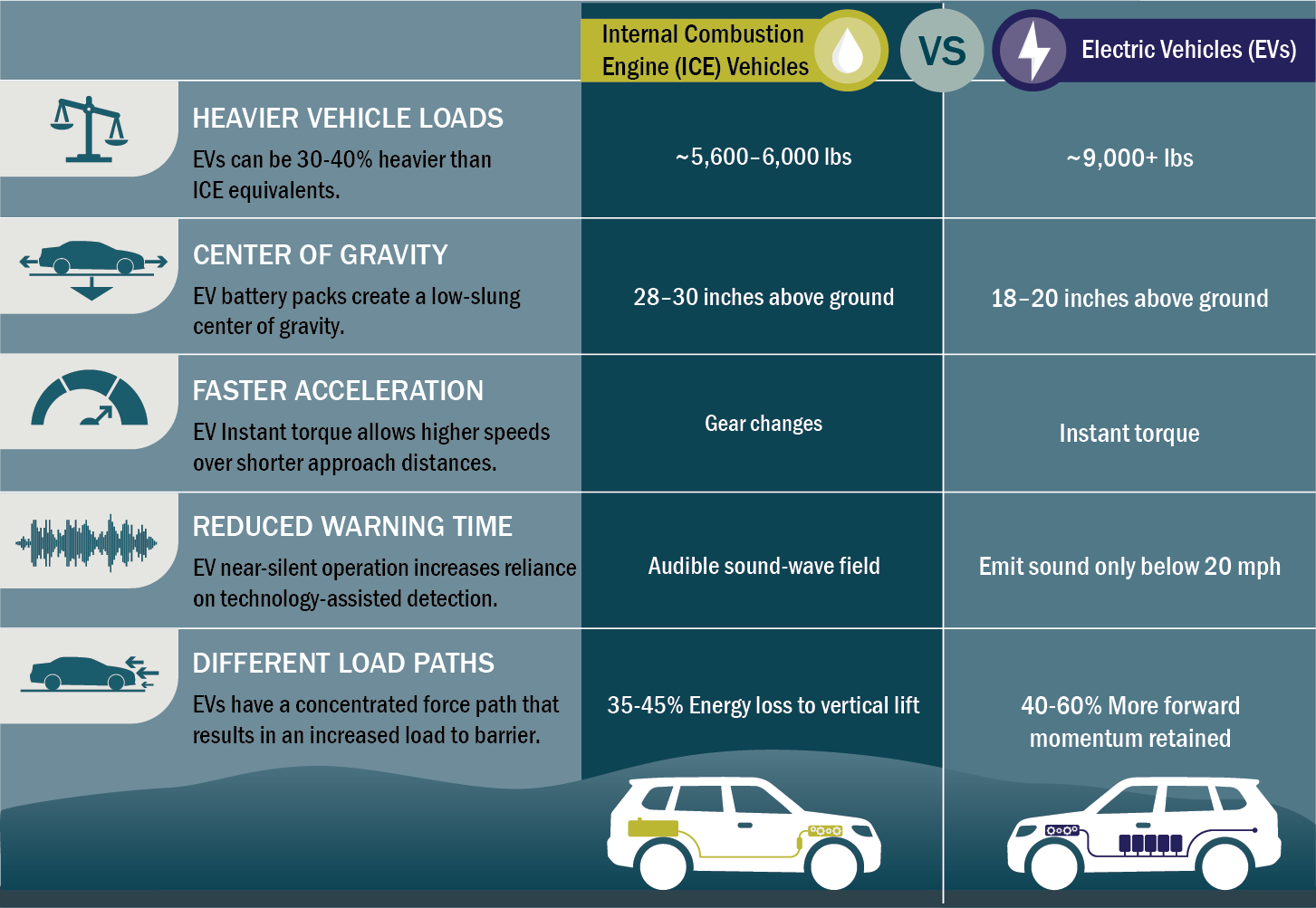
Electric vehicles (EVs) are becoming standard across passenger, fleet, delivery, and service applications. Their weight, rapid acceleration, and low center of gravity do not make them inherently more dangerous than internal combustion vehicles. They do, however, challenge long-standing assumptions that can shape perimeter design.
Because perimeter systems often remain in service for decades, owners should periodically verify that threat assessments reflect current and anticipated vehicles, site conditions, and operating demands throughout the facility’s life.
ASTM F2656 Remains Essential
ASTM F2656, Standard Test Method for Crash Testing of Vehicle Security Barriers, remains the primary benchmark for evaluating barrier performance. It establishes consistent vehicle classes, test speeds, and penetration measurements, enabling owners and designers to compare products and define performance expectations.
A crash rating, however, documents performance under a specific test condition; it does not establish suitability for every vehicle, approach angle, roadway, or consequence scenario. Curves, grades, shoulders, queues, service roads, and operating constraints may differ substantially from a controlled test environment. Effective protection therefore pairs tested equipment with site-specific analysis.
Why EV Characteristics Matter
Many EVs are heavier than comparable internal combustion vehicles because of their battery systems, and some can accelerate rapidly from a stopped or low-speed position. Battery placement can also affect center of gravity and handling. Together, these characteristics may influence achievable approach speed and the impact energy a protective system must manage.
Impact outcomes still depend on the specific vehicle, mass, speed, angle, structural characteristics, barrier design, and site conditions. EVs should not be treated as a separate threat category. Rather, they reinforce the need to use representative vehicles and realistic approach conditions when validating perimeter assumptions.
Perimeter strategies also should not rely solely on vehicle noise or human observation. Audibility varies with vehicle type, speed, background noise, buildings, landscaping, and roadway geometry. Video analytics, vehicle detection, access-control alarms, and defined response procedures can provide earlier warning of an unauthorized approach.
Layered Protection and Consequence-Based Design
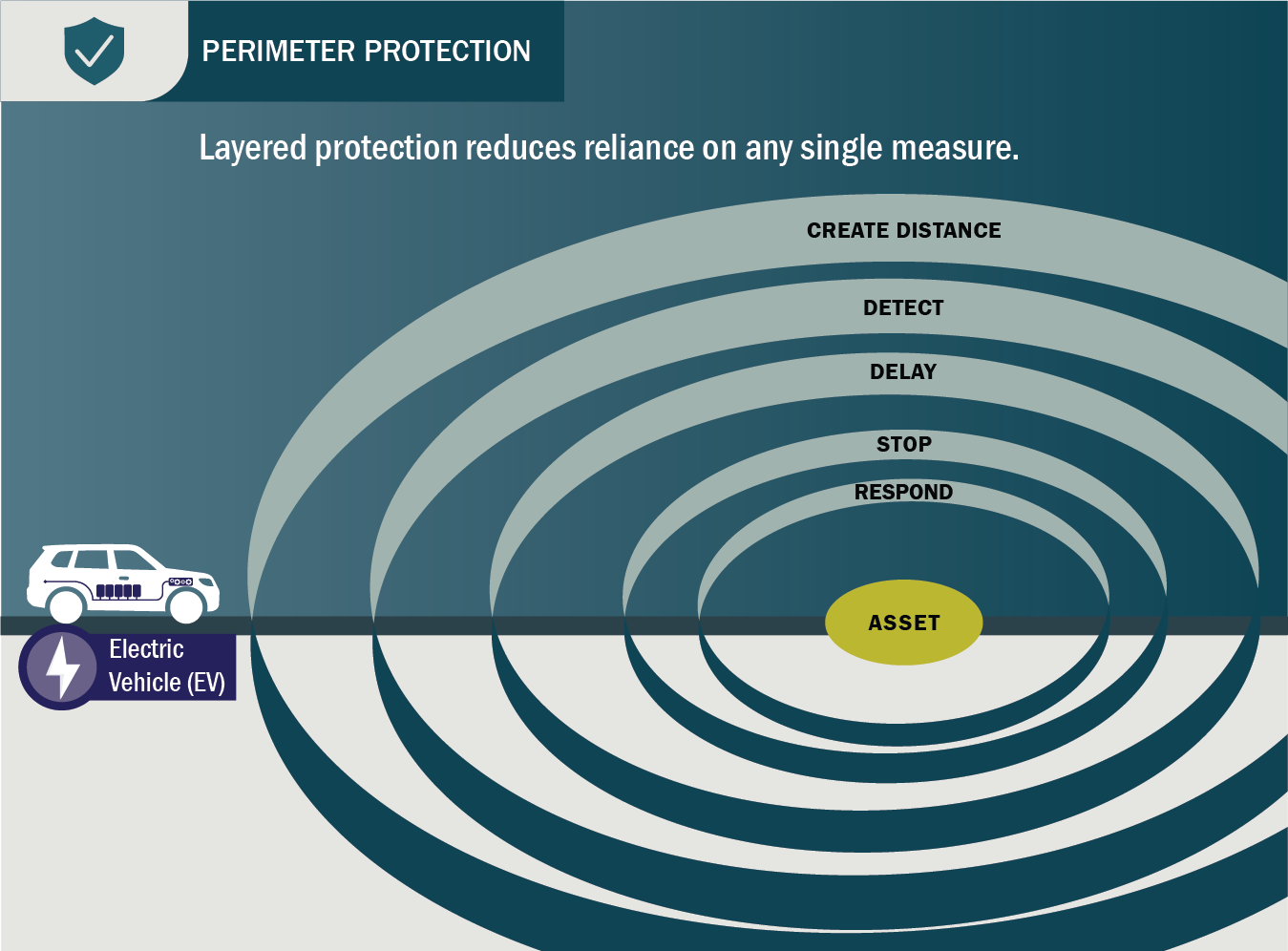
Resilient perimeter protection rarely depends on a single barrier. Layered designs integrate site planning, roadway geometry, standoff, fixed or active barriers, access control, surveillance, lighting, and response procedures. Curves, offsets, medians, controlled lanes, grade changes, and engineered landscape features can reduce vehicle speed before an approach reaches a critical location.
A complete strategy coordinates detection, delay, distance, stopping capability, and response. Consequence-based design directs investment toward assets and occupied areas where a breach could cause the greatest injury, disruption, or economic loss. This approach avoids overprotecting low-consequence areas while strengthening the locations that matter most.
Airports
Airports combine public roadways, passenger drop-off areas, parking, cargo operations, service roads, and restricted airside access. During terminal expansions, roadway projects, gate replacements, and perimeter upgrades, owners should reassess short acceleration zones, curved approaches, shoulders, and alternate paths that could allow a vehicle to gain or maintain speed.
Crash-rated equipment should be coordinated with roadway geometry, standoff, credentialing, surveillance, guard operations, and emergency access. The objective is to reduce vehicle-borne risk without impeding passenger movement, deliveries, tenant operations, or daily airport activity.
Rail and Transit Facilities
Rail and transit facilities often place stations, platforms, bus facilities, substations, and operations centers near public roads. Risk is greatest where a short, direct approach leads to a crowded entrance, passenger queue, or critical operating space.
Effective solutions may combine traffic-calming geometry, bollards, streetscape elements, controlled service entrances, and separation between public and operational zones. In dense urban settings, these measures must balance protection with accessibility, pedestrian circulation, mobility, and integration with the surrounding community.
Commercial Properties and Higher Education
Commercial properties, healthcare campuses, and higher education institutions are open environments where vehicles, pedestrians, cyclists, deliveries, visitors, and events converge. Owners should focus on high-occupancy gathering areas, roadway-aligned entrances, plazas, residence halls, event venues, and loading zones.
Circulation changes, grade separation, landscape features, architecturally integrated security elements, controlled loading access, and strategically placed barriers can improve protection while preserving accessibility, aesthetics, and the user experience.
Data Centers, Power Plants, and Central Utility Facilities
For data centers, power plants, water treatment facilities, and central utility plants, the principal concern is operational continuity. A breach could damage substations, transformers, generators, cooling systems, control rooms, or other assets whose loss would disrupt essential services beyond the site boundary.
Threat assessments should examine entrance roads, inspection points, delivery gates, and internal routes leading to high-consequence assets. Multiple control points, adequate standoff, protected guard positions, inspection areas, redundant barriers, and recovery procedures can reduce reliance on any single protective measure.
Questions Owners Should Ask
When planning a perimeter upgrade, expansion, security assessment, or capital project, owners should consider the following questions:
- Does the current vehicle threat assessment reflect the vehicles using the site today and those expected during the life of the facility?
- What speed could a vehicle realistically achieve along direct, curved, or secondary approaches to critical assets?
- Which facilities, operations, or occupied areas would experience the greatest consequences if perimeter protection were breached?
- Are roadway geometry, standoff distance, landscaping, and circulation patterns being used to reduce risk before a vehicle reaches a barrier?
- Are crash-rated barriers being evaluated as part of a complete protection strategy that includes access control, surveillance, operational procedures, and emergency response?
- Have changes in traffic patterns, site development, or facility operations created new vehicle approaches that were not considered in the original design?
- When were the site’s perimeter assumptions last reviewed, and do they still reflect current conditions and future expectations?
The vehicle fleet is evolving, and perimeter planning must evolve with it.
Securing Future Investments
The vehicle fleet is evolving, and perimeter planning must evolve with it. EVs do not invalidate existing standards or automatically require the replacement of gates, barriers, bollards, or access-control systems. They do provide a practical reason to reexamine the assumptions underlying perimeter strategies.
ASTM F2656 remains essential, but real-world performance also depends on roadway geometry, achievable speed, standoff, operations, emergency access, and the consequences of a breach. The most resilient designs pair tested barriers with layered protection, operational controls, and consequence-based planning.
The objective is not to redesign every perimeter simply because EVs exist. It is to ensure that future investments reflect current conditions rather than outdated assumptions. Periodic reassessment enables owners to strengthen safety, sustain operations, and protect critical assets throughout the facility’s life.


